Sunday, April 11, 2010

Providencia and the Bay Islands

We arrived at the island of Providencia on January 22nd after a 42 hour passage from Colon, Panama. It was at times our most uncomfortable sailing yet as the seas were very steep and confused, 8-10' on our beam.  We were sailing close hauled in 20-25 knots of wind.  Made for a noisy, wet and bumpy ride, but the boat felt solid and we managed to sleep well enough. The picture above is of our chartplotter screen showing our boat (the black symbol), on top of a significant reef at the entrance to the harbour at Providencia. Not to worry, because we were actually in the clear channel to our port.  This is just an illustration of the intermittent  inaccuracy of electronic charts. A reminder to watch where we're going!


We did some nice walks on Providencia and the adjoining island of Santa Catalina which is connected by a foot bridge.  This is the view over the main harbour.  Idyll Island is anchored just below us.


We didn't walk everywhere.  Rented a scooter (Derek wants a real motorcycle!), and spent a day touring around the island. You could do it in under an hour without breaking any speed limits, but we took our time and stopped along the way.  Everyone on this island rides scooter or small motorcycles. There are only a few cars and the odd small pick-up truck.  You frequently see families of 4 on one scooter.  The craziest we saw was a couple of guys on a small motorcycle dragging a big bundle of 15' long rebar down the road behind them - sparks flying everywhere!

One of the places we stopped was Roland's - you have to stop at Roland's when you're on Provo.  Here is de mon hisself preparing our fish for lunch.  In spite of being a territory of Colombia, most Provo Islanders speak English with a West Indian dialect.  Many proudly trace their roots back to the pirate captain, Henry Morgan and his crew, who used this island as a base from which to intercept the treasure ships returning to Spain.
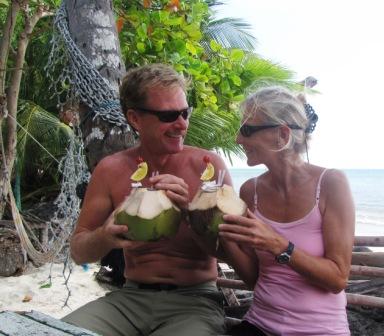
Waitin' for our fish to cook - may as well have a fancy drink.

And have a swing on the beach.

Ah, here's de fish.  And it was delicious.

On the waterfront at Providencia.  Its a very clean and tidy island. The inhabitants take obvious pride in the beauty of this place and work to keep it that way.

Morgan's Head.  From the seaward side the rock on this point looks like a human head - sort of.  There are caves honeycombing the island and just below us legend has it that there was a stash of treasure.  We didn't find any - not that we would say if we did...  By now all the easy pickins are gone, but there are probably wrecks still to be found out on the reefs, because the waters around here are pretty tricky to navigate even with modern navigation systems (see first picture in this post!).  There are lots of cannons around though, attesting to the pirate's presence.

One evening we invited all the other boats in the bay to join us for sundowner drinks and appies. As usual, these events tend to extend well beyond sundown.  Lots of fun and some very interesting people. In this group was a retired Hollywood camera man, his ex-actress wife and a profesional extreme snowboarder. You just never know who's out here!

Much as we enjoyed Providencia, we got a forecast from Chris Parker for perfect weather to make the 400 mile passage to the Bay Islands of Honduras. So it was time to leave.  We have to say that the people of Providencia were some of the friendliest and helpful we have met yet.  We had one fellow offer to drive us to a restaurant at the other end of the island and then to call him anytime of the night and he would come and pick us up. This was after he had filled our SCUBA tanks - for free!

After a much more enjoyable, faster and smoother passage than the last one (30 hours with the spinnaker up), we arrived in the Bay Islands of Honduras at the island of Guanaja.  The main town is on a small off lying island (used to be three but they sorta got built over into one).  The houses are densely packed, extending out over the water and there are no motorized vehicles - everyone gets around by boat of some kind.  Again, while part of Honduras, many people here speak English as their first language, their ancestors having come here from Jamaica for work.

The beautiful little island of Josh's Cay (recently renamed Graham's Cay by the new owner - Graham), just off Guanaja.  We anchored off - far enough off to avoid the sand flies! Had a couple of days here all by ourselves.  Snorkeled and Derek tried to catch a bonefish on his fly rod. Graham's Cay is actually a world renowned bonefish and permit fly fishing spot. Graham told us how one of his customers cast a fly from his seat at the dinner table and caught a bonefish.  Well sure enough there are lots of bonefish but after hours of stalking them and casting endlessly, Derek had not hooked even one.  They were practically bumping into his legs as he waded in the shallows.  And they were big!

In the background are the rocky remains of the old Roatan Dive Lodge where we visited, along with friends Jim, Jeannie, Dave and Ron on our first vacation together back in 1983.  The lodge burned down about 10 years ago and the jungle has quickly reclaimed it.  Brought back many memories...

That's a lot of iguanas!  The Roatan iguana refuge. Ones in the wild are sought after as an alternative to chicken. Having tried iguana soup back in Bonaire, Derek can attest to its tastiness.  

We don't have many pictures of Guanaja and Roatan as the weather was pretty wet and gloomy much of the time due to a series of cold fronts. And when it wasn;t we went diving.  Diving was great at Roatan, possibly the best we have  seen in the Caribbean. Relatively healthy corals with good diversity, fabulous, steep walls dropping into the deep blue, 100' visibilty, and lots of interesting fish.  We also hung out with some great people in the Bay Islands.  We'll never forget watching the Olympic gold medal hockey game with a bunch of other Canucks under the palm trees on the dock at Fantasy Island marina!


Wednesday, March 3, 2010

San Blas and Panama - Continued

We left the San Blas islands just before Christmas and spent 2 days sailing along the Panamanian coast to Colon; the Caribbean entrance to the canal.  We tied up the boat at Shelter Bay Marina - really the only option now that there is no safe place to tie up a dinghy in town. While there getting provisioned and cleaned up for Tristan's Christmas visit, we re-met Ted and Veronique of Verite, a Catana 50 catamaran.  They are a fun and energetic couple who we first met in the Rosarios Islands near Cartagana.  They asked if we would be interested in joining them as line handlers on their transit through the canal.  We jumped at the chance not only because it would be great experience for when we eventually take Idyll Island through, but because we knew it would be great fun with them. And the timing was perfect for getting to Panama City to meet Tristan. 

 
 Cathy and Derek aboard Verite about to enter the Gatun locks at dusk on the Caribbean side of the Panama Canal.  As line handlers, we had to catch the messenger lines attached to weighted balls (monkey fists) thrown down (40') to (or at) us by the lock workers, make fast our heavy mooring lines and then constantly adjust the tension on the lines as locks filled or emptied to keep Verite centered in the lock against the pressure of the in-rushing (or out-flowing) water.

  
 We had to stay overnight in Gatun Lake.  When it came time (0615) to raise the anchor the next morning to proceed across the Lake to the Miraflores locks, it turned out that Verite's anchor chain was wrapped around a submerged 10 m long tree.  Skipper Ted had to jump into the water with a saw to clear the obstruction before we could get underway.  There are fines for delaying the transit and there are crocodiles in the lake!

  
 You can't see them, but there are lots of big ships in the 20 km channel through the Gatun Lake and Guillard Cut.  Requires a fair bit of concentration to avoid being run over.

  
 Our Canal adviser from the first day, Alvir.  This is the second day when we had another adviser on board.  Alvir took the day off to rejoin us on his own time - wonder why...?

  
 The Bridge of the Americas, connecting North and South America, behind us, we are in the Pacific - if only briefly this time. We had a great couple of days with Ted, Veronique and Ted's mother and sister.  And Alvir!


 Tristan arrived safe and sound, if somewhat tired after his 2 day journey to join us and a tough semester at college.  This is Christmas Eve at the Miraflores Lock visitors centre where we stopped on our way back across the isthmus by taxi to the marina and Idyll Island. The visitors centre with its extensive museum is an interesting stop. Making it even more interesting for us, if not bizarre, was running into Derek' cousin from Vancouver and his family, who Derek had not seen for over 15 years!  


Christmas morning on Idyll Island at Shelter Bay Marina. We're together, cards and presents from friends and family and champagne for breakfast. 

 
 Somehow on Christmas Day there was a point when we only had one tin of beer in the pool....

  Waterpolo skills were employed by one of us....

  
Someone swallowed more pool water than beer...

  
And in the end youth triumphed - this time....

  
Christmas day afternoon in the marina pool.  Luckily we were able to find some more beer! 

  
On Boxing Day we sailed back to the San Blas Islands.

  
Finding the right spot to drop the anchor is always challenging and requires good coordination between the foredeck and the helmsman. 

  
Tristan jumped in with Derek's Christmas speargun to see if he could find dinner.  Unfortunately the San Blas have been heavily overfished and there are very few fish of a size worthy of spearing.  We did not take any.

  
Cooling off while floating on our pool noodles with a couple of cold ones.  A trick taught to us by friends Chris and Kelly on Verna Breeze.


Cathy learning how to fly a kiteboard kite with our friend John from Tyee III.  John, his wife Lucy and their boys; Theo and Simi, are from Revelstoke BC.   They are now headed for the South Pacific.

  
Cathy looking at more molas.  She managed to resist - this time.

  
In the San Blas there are a few stores but we were unable to find any fresh produce in them.  Luckily, the veggie boat comes out to some of the anchorages and pulls up alongside

  
The island of Linton between Colon and the San Blas is uninhabited except for a troop of monkeys who are clearly in charge.

  
What the heck is this?  An apple?  The other guys gave me.....

  
... a whole bag of Cheezies!

  
Scary but tasty.  Barracuda are one of our favourite fish to eat.

  
Yoga under the palm trees on Potluck Island.  Led by Suzanne from Nautibear, this must be the most perfect place on the planet for yoga.  It was Tristan's first experience and he's doing his "tree" position perfectly - the size 14 feet probably help.

After an exhausting day of yoga and snorkeling we need to get our strength back with a huge plate of ribs.  Yum!

Potluck on Potluck Island.  A regular weekly event and chance to meet cruisers from all over the world. The island is maintained in park-like perfection by Reg of Runner, who with his wife Debbie have been cruising the San Blas for 14 years.

  
Mixed seafood grill for New Years Eve dinner with our Italian friends. 

  
After dinner sing along - in Italian, and French and English.  A very cosmopolitan and fun New Years Eve. Thanks to Marco, Enrica and little Pablo!

 
On the way back to Colon we stopped at Linton again and this time visited the sloths. Actually we visited with Binnie and Roger who welcomed us warmly though we were unannounced.  They live with 3 rescued sloths - gentle and fascinating animals related to possums and anteaters rather than monkeys.

Thursday, February 25, 2010

San Blas Islands, Panama - First installment

We departed Cartagena on November 21, 2009, bound for the San Blas Islands of Panama, a distance of 150 miles. But first we made an overnight stop at the Islas Rosarios, just 18 miles off Cartagena, so we could scrape off the 1000s of barnacles that had grown on our hulls during the 10 days we had been in the heavily 'enriched' waters of Cartagena harbour.  It  took the 2 of us almost 4 hours but the water was clear a gorgeous.  Next day we left the anchorage and hoisted the spinnaker for a  21 hour overnight sail in light breezes.  Dolphins came to play at dawn.  Our first sighting of Kuna Yala, the native Kuna people's name for the San Blas, was of many low lying islands backed by misty, jungle covered hills of the mainland. In some ways reminiscent of the BC coast.  We worked our way through the reefs and anchored in behind a little palm covered island.  Locals in their dugout canoes, were paddling and sailing all around. They waved, but otherwise ignored us as they went about their business of fishing, lobster diving, heading up river to work their fincas (farms) or off to tend the islands.


 Kuna village with lush mainland hills layered behind. We had to wait a week until the clouds lifted to get a sunny picture - it was the end of the 5 month rainy season.


 Kuna father and son heading home from the fishing grounds.

 A typical San Blas island.  There are many hundreds like this along the hundred km coastline.  The Kunas tend the palms and harvest the coconuts.  Every tree belongs to a village.


 Kuna village waterfront.  The outhouse on the right just hangs out over the water. The reed and thatch houses are densely packed, with only narrow paths between them.  The islands are very low, with typical elevations of only 2-3'.  Storm surge and rising sea levels make fighting erosion a constant job.


The kids are alright!  Kuna kids were very friendly and would run up and take our hands to lead us through their villages.  In contrast to the adults, they loved to have their pictures taken.  Behind them is a dugout canoe or ulu, nearing completion.  Takes a long time with only hand tools.


These guys were up for a game of balloon volleyball - and anything else!


 Molas are the traditional front and back panels which decorate the blouses of Kuna women and have become a renowned form of folk art. They consist of intricate, often geometric designs, created from multiple cut-through layers of fabric and extremely fine embroidery.  One mola can take more than a month to complete.  She was one of only two woman willing to have her picture taken (in the six weeks we there!) and she crouched over so far that her mola can't be seen, though her nose ring can.


 Little girl and her grandmother wearing molas and navy wrap skirts. The grandmother is also wearing the traditional beaded leggings and bracelets.  She allowed us to take her picture because we bought two of her molas.


 Master mola maker, Venancio.  It was difficult to choose from amongst his dozens of fine works. So we bought several - actually, more than several....
 

 A more modern design with the upper part of the blouse cut away after we bought it.  The bits would be reused.


We should get sails like that!