Isla Floreana - the island of flowers

Approaching Floreana after a quiet motor sail of 54 nm from San Cristobal, and our fill of fresh banana nut muffins, we saw numerous ‘black turtles’, the same species as the Caribbean greens, lounging about on the calm surface. Then largish, slowly swirling lumps with the occasional flipper or head emerging clued us in to the mating activities. We paused for a while then carefully wove our way into the quiet bay. Floreana is the smallest of the four inhabited islands – population about 100. There are no stores or food available and the several small patio eateries attached to local houses were closed. Again the hoped for tourist boom has faded as in the Caribbean and Central America. We did have a lovely prearranged meal at the local hotel overlooking a black sand beach, run by the descendants of the Witmers, an early pioneering family on the island. The book of their experiences makes a very good read. ‘Idyll Island’ and the Aussie catamaran, ‘Pelagic’, with Iris and Graeme (our companions since Panama) were the only cruisers there the whole week.

A hot hike along the coast led to Punta Cormorant. From here we had a clear view of the Black turtles running the swells through the small pass and feeding in the reefs either side.
Along with Iris and Graeme, we hitched a very rough 5km truck ride up one of the volcanic cones mid-island to the Pirate Caves, temporary homes to the first inhabitants (no indigenous people) who sought the fresh water springs there. The truck was to pick us up a couple of hours later so we hiked around the area taking in the views, the Witmer homestead built while sheltering in the caves (their first son was born in a tiny cavern – tough folk), and many types of fascinating geological formations resulting from the island’s volcanic origin.
Nice on a sunny day, but not sure that it would have been our choice for long term habitation through torrential rains, as it was for the Witmer family back in the early 1900s.
"The sun doesn't seem to be helping my skin condition..."
The many dark lava rock beaches are littorally littered with well camouflaged marine iguanas basking in the sun or clinging to the surf-washed rocks, eating the low, bushy algae growing there - and always shedding. They ranged from 15 cm to over 1m in length. We would sit down or jump to a rock and find ourselves face-face with one or more of these.
Santa Cruz Island
A thriving, busy port appealing to adventurous tourists, boasts interesting shops and great little restaurants along the harbour front and several very nice, small scale hotels. We enjoyed lots of beach and inland hikes, many tasty and reasonable lunches out – a rare treat on a cruiser’s budget, and an island tour. The island has deep but verdant caldera, an extensive tortoise reserve, interesting vegetation adapted to the ascending altitudes, the Darwin Research Center and Sanctuary, and surprisingly, a major Sea Shepherd office with a 30 m long, high tech, tri-hull speed boat.
"Is it fresh today?"
Sushi Bar, Galapagos style...
These guys are vicious. We saw one attack a pelican over a piece of fish. It stabbed the pelican with its beak, seriously wounding it. The pelican was unable to fly and barely walk as it retreated down the sidewalk. All nature, all the time in the Galapagos.
The exotic, naturally opened fruit of a native vine. Though it’s the dry season, some of the flora were pretty amazing.
Lava tubes formed by escaping hot gas or a lava river create many tunnels and caverns and odd surface formations on the islands. This one, about 1/2 km long, and from less than 1 meter to 10 meters high made an interesting and cool respite from the 33 degree heat of the above ground part of our tour.
Now that's a cerviche! Not bad for $12, plus a big frosty cold beer for $2. A bit pricier than most of our lunches, but worth it. Life is good!
ISLA ISABELLA
If forced to choose, this would be our favorite Galapagos Island. Isabella is the most recently formed of the 5 inhabited islands with five occasionally active volcanoes. Though it is by far the largest island it has a small population and is quiet, laid back with lots of hikes and shoreline to explore and best of all, has wildlife playing and feeding around the anchorage most of the day and much of the night. The walk to the small town is about 2 km, all roads are of sand and there is nothing resembling a resort. There are two very small grocery stores and a somewhat squalid market with 3 stalls, but we were glad to get whatever fresh food was available. This involved making visits over several days to be there when anything came in from the few farms or a small, seldom appearing supply boat.

Our first trip ashore let us know that we were back in the land of marine ‘lobos’, most of them Galapagos Fur Seals. This species is different than the larger Galapagos sea lions at San Cristobal – being smaller, quieter and well behaved and not attempting to take over our boat. However, this local water taxi, left unattended for some days, was fair game.
Derek, Graeme and Iris are checking out the lovely beach park which fronts the town. There were just a few other cruising boats and likely not more than 20 land based tourists visiting the island. There was great camaraderie among the boats, visits back and forth, morning swims together with the penguins and fur seals, energetic water tag centering around the kids from ‘Bonaire’ and a beach bbq featuring water play, Frisbee football and masses of grilled tuna, salads, Cathy’s (previously Renate’s…) famous rum cake, etc. Only a small number of cruisers choose to pay for the 4/5 island 6 week permit; (about $1000 total), the three week/one island (either San Cristobal or Santa Cruz), is more normal and affordable. We feel very privileged and fortunate to have had the time to experience these fabulous islands more fully.
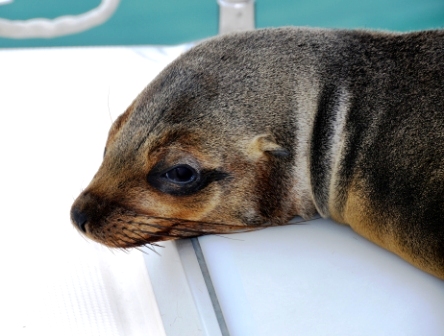
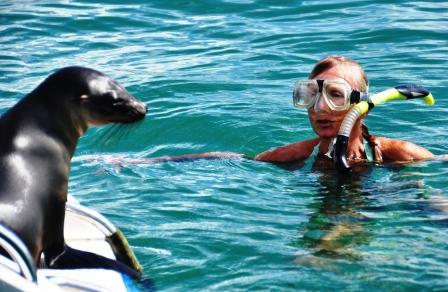
This young fur seal took over our back step from the day we arrived until we left 18 days later. Fur seals generally hunt during twilight and darkness. We often heard the slap of a tail against the hull at night as they chased fish seeking shelter near our hulls. Daytime was for play and siestas.
Laguna Salinas is a one hour local speed boat trip from the anchorage. Acres of lava arches, tunnels and a maze of waterways make up the amazing, rugged topography.
A rather bedraggled little Galapagos Penguin standing in the rain. Quite a difference from the energetic, high speed creatures we see dashing around the boat daily.
Part of the speed boat tour was a snorkel in the mangroves with turtles, black-tipped reef sharks and many fish including this 18cm seahorse. Yes, peering through the murky water waiting for sharks to materialize was exciting. Actually the best view of several sharks circling amid large clouds of brave little yellow fish (convict surgeon fish), was through an underwater arch illuminated from above and behind – stunning.
Another common and sometimes messy, visitor to the boat. Gotta wonder how they manage those massive bills on that long skinny neck, particularly when wrangling a pouch full of wriggling fish. Love these guys; they are always amazing and entertaining.
Junior playing with her dinner 5 m from the boat.
A little Blue Heron nabbing a tiny Sergeant Major while perched on our dinghy painter.
Excuse me - you’re blocking the ladder.
So sleek, so graceful and so fast that we never did get a decent underwater seal shot. But, we did have many wonderful times swimming with them. Whenever we jumped into the water and executed a few of our own graceful (?) summersaults, a couple of fur seals would turn up and show us how it was really done. We blew bubbles and they blew bubbles. All concerned enjoying it immensely.Wonder how they do all that rapid gymnastic display and not get dizzy. We had a hard time even figuring out which way was up after a while.
Wonderful to watch from the deck or in the water, the penguins dashed and darted in all directions trying to separate one out of a school of tiny fish to slurp down. They actually fly under water as they no longer can in the sky.
One of the many hikes we did was to the local tortoise sanctuary. This was a particularly good one with egg collection, incubation and year classes raised to 6 years before release. The big chap on top is well over 100 years old but his lady friend doesn’t seem too impressed. All the other tortoises in that compound shuffled over to watch the action - all in slow motion but accompanied by enormous groans and grunts.
Yep, the sea-strainer for the water maker works. Strained this little guy out. He was a bit too mangled to join us for sushi dinner.
Finally time to raise anchor for the three week passage to French Polynesia, but our mascot didn’t want to leave us. He actually followed the boat for about 1 km as we left the anchorage!
Farewell to the wonderful Galapagos. Isla Isabella with its main volcano hidden in a rain squall.
Provisioning (if you are interested)
Poor old Idyll Island is heavily loaded with every kind of supply and boat part. This is Tristan’s/guest berth, packed to the ceiling, as are the third berth and the quarter berth. The port head is the home of the little, much appreciated, washing machine we bought in Panama.
So how do you prepare for an 8 month, 8,000+ nautical mile (14,000 km) season in the South Pacific where there are only a scattering of gorgeous but for the most part, sparsely populated and supplied islands? If you are us it is with gusto and possibly excess. Panama City is very inexpensive for most things and a wonderful place to begin the adventure. Cathy filled 18 large laundry baskets with hundreds of cans (meat, fish, veg, fruit, beans, soups) oils, condiments, dried fruit, whole grain products such as flour (30 kgs whole wheat and 15 kgs unbleached white), pastas (50 pkgs), rice (35 kg) and cereals; baking supplies, lots of herbs and spices, vitamins, paper products, medical supplies, gallons of vinegar (for cleaning) and anything else you might imagine. Everything had the packaging removed, was labeled, dated, inventoried and protected from moisture (humidity typically 60 to 80%) and the possibility of insects using xxl ziplock bags or lock ‘n lock containers. The large freezer was filled to capacity and an inventory kept. Derek focused on spare parts for the boat (which of the thousands of things are going to break/fail?), his beer locker and the bilge fillers – wine and spirits, installing a new sprit and screecher (yay), diagnosing and repairing the water maker (again), the SSB radio… motors repaired/maintained, alternator replaced (again)….. During the 5 months prior to leaving Panama we had 4 very large orders shipped in from Marine Warehouse (boat parts and more boat parts, vitamins, 2 Kindles (great way to have a library on board!), more fishing gear ++). Oh yes, we picked up a surf board. The boat has sunk several inches. Cats are meant to be light and fast –we have become Garfield!