Monday, August 15, 2011

Galapagos II


Isla Floreana  -  the island of flowers

Approaching Floreana after a quiet motor sail of 54 nm from San Cristobal, and our fill of fresh banana nut muffins, we saw numerous ‘black turtles’, the same species as the Caribbean greens, lounging about on the calm surface.  Then largish, slowly swirling lumps with the occasional flipper or head emerging clued us in to the mating activities.  We paused for a while then carefully wove our way into the quiet bay.  Floreana is the smallest of the four inhabited islands – population about 100.  There are no stores or food available and the several small patio eateries attached to local houses were closed.  Again the hoped for tourist boom has faded as in the Caribbean and Central America.  We did have a lovely prearranged meal at the local hotel overlooking a black sand beach, run by the descendants of the Witmers, an early pioneering family on the island.  The book of their experiences makes a very good read.  ‘Idyll Island’ and the Aussie catamaran, ‘Pelagic’, with Iris and Graeme (our companions since Panama) were the only cruisers there the whole week.


A hot hike along the coast led to Punta Cormorant.  From here we had a clear view of the Black turtles running the swells through the small pass and feeding in the reefs either side. 


Along with Iris and Graeme, we hitched a very rough 5km truck ride up one of the volcanic cones mid-island to the Pirate Caves, temporary homes to the first inhabitants (no indigenous people) who sought the fresh water springs there.  The truck was to pick us up a couple of hours later so we hiked around the area taking in the views, the Witmer homestead built while sheltering in the caves (their first son was born in a tiny cavern – tough folk), and many types of  fascinating geological formations resulting from the island’s volcanic origin.


 Nice on a sunny day, but not sure that it would have been our choice for long term habitation through torrential rains, as it was for the Witmer family back in the early 1900s.
 
"The sun doesn't seem to be helping my skin condition..." 
The many dark lava rock beaches are littorally littered with well camouflaged marine iguanas basking in the sun or clinging to the surf-washed rocks, eating the low, bushy algae growing there - and always shedding.  They ranged from 15 cm to over 1m in length. We would sit down or jump to a rock and find ourselves face-face with one or more of these.

Santa Cruz Island
A thriving, busy port appealing to adventurous tourists, boasts interesting shops and great little restaurants along the harbour front and several very nice, small scale hotels.  We enjoyed lots of beach and inland hikes, many tasty and reasonable lunches out – a rare treat on a cruiser’s budget, and an island tour.  The island has deep but verdant caldera, an extensive tortoise reserve, interesting vegetation adapted to the ascending altitudes, the Darwin Research Center and Sanctuary, and surprisingly, a major Sea Shepherd office with a 30 m long, high tech, tri-hull speed boat.

"Is it fresh today?"

Sushi Bar, Galapagos style...

These guys are vicious.  We saw one attack a pelican over a piece of fish. It stabbed the pelican with its beak, seriously wounding it. The pelican was unable to fly and barely walk as it retreated down the sidewalk. All nature, all the time in the Galapagos.

The exotic, naturally opened fruit of a native vine. Though it’s the dry season, some of the flora were pretty amazing.


Lava tubes formed by escaping hot gas or a lava river create many tunnels and caverns and odd surface formations on the islands.  This one, about 1/2 km long, and from less than 1 meter to 10 meters high made an interesting and cool respite from the 33 degree heat of the above ground part of our tour.


Now that's a cerviche!  Not bad for $12, plus a big frosty cold beer for $2. A bit pricier than most of our lunches, but worth it.  Life is good!


ISLA  ISABELLA
 If forced to choose, this would be our favorite Galapagos Island.  Isabella is the most recently formed of the 5 inhabited islands with five occasionally active volcanoes.  Though it is by far the largest island it has a small population and is quiet, laid back with lots of hikes and shoreline to explore and best of all, has wildlife playing and feeding around the anchorage most of the day and much of the night.  The walk to the small town is about 2 km, all roads are of sand and there is nothing resembling a resort.  There are two very small grocery stores and a somewhat squalid market with 3 stalls, but we were glad to get whatever fresh food was available.  This involved making visits over several days to be there when anything came in from the few farms or a small, seldom appearing supply boat. 
Our first trip ashore let us know that we were back in the land of marine ‘lobos’, most of them Galapagos Fur Seals.  This species is different than the larger Galapagos sea lions at San Cristobal – being smaller, quieter and well behaved and not attempting to take over our boat.  However, this local water taxi, left unattended for some days, was fair game.

Derek, Graeme and Iris are checking out the lovely beach park which fronts the town.  There were just a few other cruising boats and likely not more than 20 land based tourists visiting the island.  There was great camaraderie among the boats, visits back and forth, morning swims together with the penguins and fur seals, energetic water tag centering around the kids from ‘Bonaire’ and a beach bbq featuring water play, Frisbee football and masses of grilled tuna, salads, Cathy’s (previously Renate’s…) famous rum cake, etc. 
Only a small number of cruisers choose to pay for the 4/5 island 6 week permit; (about $1000 total),  the three week/one island (either San Cristobal or Santa Cruz), is more normal and affordable.  We feel very privileged and fortunate to have had the time to experience these fabulous islands more fully.
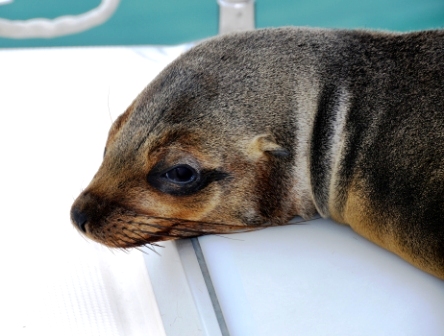
This young fur seal took over our back step from the day we arrived until we left 18 days later.  Fur seals generally hunt during twilight and darkness.  We often heard the slap of a tail against the hull at night as they chased fish seeking shelter near our hulls.  Daytime was for play and siestas.

Laguna Salinas is a one hour local speed boat trip from the anchorage. Acres of lava arches, tunnels and a maze of waterways make up the amazing, rugged topography.

A rather bedraggled little Galapagos Penguin standing in the rain.  Quite a difference from the energetic, high speed creatures we see dashing around the boat daily.  


Part of the speed boat tour was a snorkel in the mangroves with turtles, black-tipped reef sharks and many fish including this 18cm seahorse.  Yes, peering through the murky water waiting for sharks to materialize was exciting.  Actually the best view of several sharks circling amid large clouds of brave little yellow fish (convict surgeon fish), was through an underwater arch illuminated from above and behind – stunning. 

Another common and sometimes messy, visitor to the boat.   Gotta wonder how they manage those massive bills on that long skinny neck, particularly when wrangling a pouch full of wriggling fish.  Love these guys; they are always amazing and entertaining.

Junior playing with her dinner 5 m from the boat.

A little Blue Heron nabbing a tiny Sergeant Major while perched on our dinghy painter.
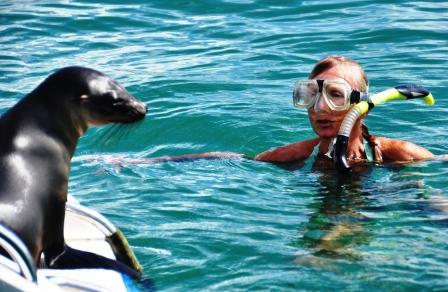
Excuse me - you’re blocking the ladder.

So sleek, so graceful and so fast that we never did get a decent underwater seal shot.  But, we did have many wonderful times swimming with them.  Whenever we jumped into the water and executed a few of our own graceful (?) summersaults, a couple of fur seals would turn up and show us how it was really done.  We blew bubbles and they blew bubbles.  All concerned enjoying it immensely.Wonder how they do all that rapid gymnastic display and not get dizzy.  We had a hard time even figuring out which way was up after a while.

Wonderful to watch from the deck or in the water, the penguins dashed and darted in all directions trying to separate one out of a school of tiny fish to slurp down.  They actually fly under water as they no longer can in the sky.
One of the many hikes we did was to the local tortoise sanctuary.  This was a particularly good one with egg collection, incubation and year classes raised to 6 years before release.  The big chap on top is well over 100 years old but his lady friend doesn’t seem too impressed.  All the other tortoises in that compound shuffled over to watch the action - all in slow motion but accompanied by enormous groans and grunts. 

Yep, the sea-strainer for the water maker works. Strained this little guy out. He was a bit too mangled to join us for sushi dinner.

Finally time to raise anchor for the three week passage to French Polynesia, but our mascot didn’t want to leave us. He actually followed the boat for about 1 km as we left the anchorage!

Farewell to the wonderful Galapagos. Isla Isabella with its main volcano hidden in a rain squall.


Provisioning (if you are interested)

Poor old Idyll Island is heavily loaded with every kind of supply and boat part.  This is Tristan’s/guest berth, packed to the ceiling, as are the third berth and the quarter berth.  The port head is the home of the little, much appreciated, washing machine we bought in Panama.
So how do you prepare for an 8 month, 8,000+ nautical mile (14,000 km) season in the South Pacific where there are only a scattering of gorgeous but for the most part, sparsely populated and supplied islands?  If you are us it is with gusto and possibly excess.  Panama City is very inexpensive for most things and a wonderful place to begin the adventure.  Cathy filled 18 large laundry baskets with hundreds of cans (meat, fish, veg, fruit, beans, soups) oils, condiments, dried fruit, whole grain products such as flour (30 kgs whole wheat and 15 kgs unbleached white), pastas (50 pkgs), rice (35 kg) and cereals; baking supplies, lots of herbs and spices, vitamins, paper products, medical supplies, gallons of vinegar (for cleaning) and anything else you might imagine.  Everything had the packaging removed, was labeled, dated, inventoried and protected from moisture (humidity typically 60 to 80%) and the possibility of insects using xxl ziplock bags or lock ‘n lock containers.  The large freezer was filled to capacity and an inventory kept.  Derek focused on spare parts for the boat (which of the thousands of things are going to break/fail?), his beer locker and the bilge fillers – wine and spirits, installing a new sprit and screecher (yay), diagnosing and repairing the water maker (again), the SSB radio… motors repaired/maintained, alternator replaced (again)…..     During the 5 months prior to leaving Panama we had 4 very large orders shipped in from Marine Warehouse (boat parts  and more boat parts, vitamins, 2 Kindles (great way to have a library on board!), more fishing gear ++).  Oh yes, we picked up a surf board.  The boat has sunk several inches.  Cats are meant to be light and fast –we have become Garfield!


Monday, March 28, 2011

Galapagos!


San Cristobal Island, Galapagos!!  Idyll Island is rocking gently while a mum and pup Galapagos Sea Lions are wedged onto the bottom transom step dozing in the late afternoon sun.  This is no easy feat as we have tied every manner of obstacle over the steps to dissuade the ‘lobos marina’, as they are known here, from boarding us.  These two are our preferred company as the bigger males are so noisy and boisterous.  Megaphone loud, resonant belches, strangled wails, exaggerated fishbone coughs that literally shake the boat; we have sea lions. They are everywhere – in any unoccupied dinghy or fish boat, park benches, the playground, all along the promenade, etc., and they are absolutely fascinating to watch.  For the North American Westcoasters reading this, they are an endemic subspecies of the familiar California Sea Lion. 

We arrived several days ago after a delightfully easy, light wind sail of just over 800 nautical miles, 6 days and 4 hours from Panama City (including 36 hours of motoring through the doldrums, aka the Intertropical Convergence Zone).  This was our longest passage so far and has us keen for more.  We watched a Brydies Whale for some time just feeding in the rich Panama waters, a shark go after a Bonita tuna that Derek released, several schools of dolphin playing in our bow waves, and dodged large freighters along the coast.  Two 700+ footers altered course for us in the middle of the night.  Kind of intimidating but they were very cooperative - even small boats have the right of way under sail.  This of course only works if they see us, which it seems that they usually don’t.  Our AIS receiver and radar together tell us the name, course, speed, length and ‘closest point of approach’, etc. of the vessel, which means that we can call them by name so they can’t (easily) ignore us.  Six hour night watches seem to work well for us.  Time passed quickly - the moon was brilliant, the sun too, no rain and the seas sparkled. 

After days out of sight of land or any other vessels, San Cristobal rose slowly on the morning horizon.  It is a magnificent welcome, verdant (we expected stark and arid) low volcanic hills punctuating the rolling green, many white sandy beaches and craggy headlands.  Pelicans, boobies, gulls and terns wheeled around us especially near the spectacular, sheer, nesting cliffs on Isla Lion Dormant.  Galapagos!  A bit of a Mecca for us biological types.  The town of Pueto Baquerizo Moreno (previously known as Wreck Bay) is delightful.   Ecuador has enhanced the long natural waterfront with beautifully designed pools, winding cobble walks and streets, numerous stone and wood gazebos, and labeled plantings of native species, all decorated with sea lions – live ones.  They are just a part of life here.  The shops and cafes are pleasantly ‘local’ and the back streets are clean but tropically basic and friendly.  Off the outer points of the bay there is a sometimes significant surf break that provides some nice rides but as it breaks on volcanic rock we declined.

We have walked with our friends Iris and Graeme (of the Aussie steel cat, "Pelagic"), to several nearby beaches where the famed Galapagos Marine Iguanas, the only salt water iguanas in the world, swim, dive, feed and sun themselves.   Blue-footed and masked boobies stand about unafraid,  bright orange Sally Lightfoot crabs scurry about and of course the sea lions cavort and laze, mums nurse their young and the immature, but sizeable, males stage playful battles (hmm, rather familiar).  There is a very impressive Interpretive Center on one of the walks, large and beautifully designed.  Today we took a 45 min taxi ride up into the hills past a tiny town and numerous small fincas (farms) to the giant tortoise breeding facility.  12 hectares of low scrub forest contain incubating and nursery areas for young up to 4 years of age and then the giants roam about on their own.  There are 11 extant subspecies in the archipelago, some evolving on different craters not too far from each other.  San Cristobal tortoises are dome-shaped while other islands have saddle-shaped or intermediate carapaces.  We hiked around the lava paths and boardwalks, heard and even saw several indigenous bird species – finches flitting about all looking too, too much the same to id to species (13 bill shapes) and newly resident bobolinks.  So far we get the best look at Darwin’s famous finches at lunchtime – the crumb-snarfing subspecies (Sidewalkus cafétierias).

Such a treat to soak up the laid back, local atmosphere, have the local water taxis know us and wave each time they pass, tune into which day the supply boat arrives with fresh fruit and veg and sus out some favorite little restaurants.   In a day or two we will be off to explore little Isla Floreana for a few days and then to three more islands – the younger ones with active volcanoes and drier more stark environments and tortoises with even longer necks.


A calm sea and light winds to Galapagos.  Cathy making adjustments to our new screacher sail (half way between a genoa and a spinnaker) which sets on a short bowsprit and rolls up on its own furler.  Should be a good set-up for downwind sailing in the trades.

 We're in the Southern Hemisphere!  We crossed the equator at night and made sure we provided Neptune (and ourselves) with a celebratory tot of rum.

 Galapagos landfall!  The rest of San Cristobal is much greener than this headland.

"Do I have to get up now?"  Despite what we thought were extensive defences, this sea lion pup managed to wiggle through and spent the night in our cockpit. Very cute, but it took about an hour to clean up the mess he left behind as he searched for just the right spot. He was even up on the table...

 "OK,what's for breakfast?"

 So we beefed up our defenses, but two more have still managed to penetrate the barriers!

 Nice of the town to put benches in for us....

 There are animals other than sea lions.  The famous Blue Footed Booby - looking good!

 The famous Marine Iguana - looking as good as they can...

Cathy talking to a young (40 year old) tortoise.

"If they would only get rid of all this junk, we could get really comfortable!"

Saturday, March 12, 2011

PanamaRama

As we get ready to sail away from Panama, where we've spent 9 of the past 15 months, here are some pictures from our time on the Pacific side.

 A nice pair of Bonito tuna caught on the way to the Las Perlas Islands, about 35 miles south of Panama City.

 Not quite sushi grade, but not bad pan seared for Christmas Eve dinner.


 Christmas morning;  huevos rancheros and champagne.

Christmas day on the beach.

A Christmas feast aboard Idyll Island. Cathy turned out an excellent turkey dinner which we accompanied with more champagne.


 Wait a minute, that's not champagne.  Tristan on one of the most beautiful beaches we've seen. A group from a neighbouring island had just finished spending 3 days picking up all the garbage and raking it clean. A great example of grass roots care for the environment.  It was pristine, and we were the only ones there!

 Tristan wake boarding on our new surfboard. 

 And Cathy is looking good too!

After Tristan returned to school in the cold and rain/snow of Victoria, Cathy's brother Jon flew down from much colder (-35) and snowier Calgary. 

 Cathy and Jon off to explore another beach in the Las Perlas.  We anchored in one big bay, all by ourselves and explored a different beach each day - for a week.  There were a few local fishing boats in the area, but other than that we didn't see another soul.

 Our friend Elvir, who piloted us through the canal, also works as an engineer on one of the canal tugs (built in PEI).  He very kindly arranged for us to spend a morning on the tug, moving a ship through the locks. Fascinating.

 Ready to see another perspective of the canal.

 We're pushing up against the side of an 800' ship with 4000 hp, all controlled through a pair of joysticks.

 A Kuna Indian, selling her molas in the old town (Casco Antigua) of Panama City.

 Restored street in Casco Antigua.

 One of the many churches.

 We've had a great time in Panama.  But its time to move on and explore the South Pacific....